Our Place in Space?
Through the Global Jet Watch project, Professor Blundell has also established a network of observatories hosted by schools around the world, giving young people the opportunity to participate in real astronomical research.
Professor Blundell's lecture asked ‘What is our place in space from the vantage point of Earth?’ She described how studying the dynamic universe is rich with amazing phenomena such as white dwarfs, novas, and black holes – phenomena that no human would ever have conceived by looking around at phenomena on Earth. She emphasised how the richness of the phenomena that we observe in the night sky is to a large extent governed by individual laws of physics – the law of gravitational attraction and the law of the conservation of angular momentum – being obeyed in combination at the same time.
Professor Blundell’s particular interest is in nova explosions and, to exemplify the power of these phenomena, she introduced a part of the galaxy known as Carina and her research on the dynamic activity within an exploded star. The effect of the temperature and pressure increase reached the level where a thermonuclear runaway reaction was created, releasing huge amounts of energy at an intensity far beyond the levels of anything experienced on Earth in, for example, the energy created in the first atomic bomb detonated in New Mexico in 1945. Supernova explosions are estimated at one a century but, with the last one being Kepler’s Supernova in 1604 when St John’s was less than half a century old, Professor Blundell hopes for the opportunity to observe one in her own lifetime.
Returning to our own planet, she explored the conditions that make Earth habitable and a possible place to survive – and thrive. Earth is a comfortable temperature: it’s in the Goldilocks zone (not too hot, not too cold, but just right). It is rocky, giving the planet a firm foundation, and has a stable thermal environment, thanks to a fairly circular orbit. It orbits around the perfect number of suns: one. Earth has clean air and a magnetosphere, a protective planetary environment that encases a planet within magnetic fields and, in the case of Earth, that is critically important for preserving us from solar radiation poisoning.
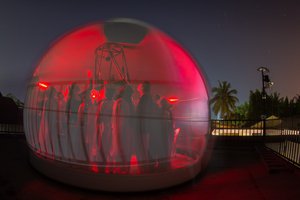
The Global Jet Watch project has a series of telescopes in observatories in Australia, India, South Africa, Oxford, Chile and New Mexico, creating a network that enables round-the-clock astronomy to follow the evolving universe. Five of the seven observatories are located in the grounds of schools with students participating in the research and the operation of the machinery, reinforcing the importance of curiosity and imagination in astrophysics research.
In concluding, Professor Blundell highlighted how observing the dynamic universe through research with telescopes helps us to realise that there is more to Earth and to life than just ourselves. It also reinforces the very special place of Earth in space, and its fragility.